If you are planning a getaway to the Cádiz coast or driving down the A-4 highway from Madrid for a few days of sun, beach, and ocean, you have likely considered trying a wind sport. However, upon arriving in Europe’s wind capital, the big question arises: should you choose Wingfoil, Windsurf, or Kitesurf?
Although all three sports harness the breeze across the Strait of Gibraltar, their overall feel, required physical effort, safety margins, and above all, their learning curve are completely different.
Quick answer for undecided travelers: If you want the most progressive learning curve — without the risk of high land traction from kitesurfing or the heavy rig weight of traditional windsurfing — Wingfoil is currently the easiest wind sport to learn and delivers the most thrilling sensation of flying over water.
Below, we break down the key differences step-by-step, compare the difficulty of each discipline, and help you pick the perfect option for your trip to Tarifa.
Main Differences Between Wingfoil, Windsurf, and Kitesurf
To understand which sport best matches your travel style and goals, let’s briefly look at what each discipline involves:
- Windsurf (The Classic): Uses a rigid sail attached directly to the board via a mast and boom. It feels heavier at the beginning since you need to uphaul the sail out of the water, but offers great stability and direct connection with the sea in lighter winds.
- Kitesurf (The Power): Connects you to an inflatable kite flying 25 meters away via steering lines. It allows high jumps and high speeds, but requires strict safety control on the beach before entering the water.
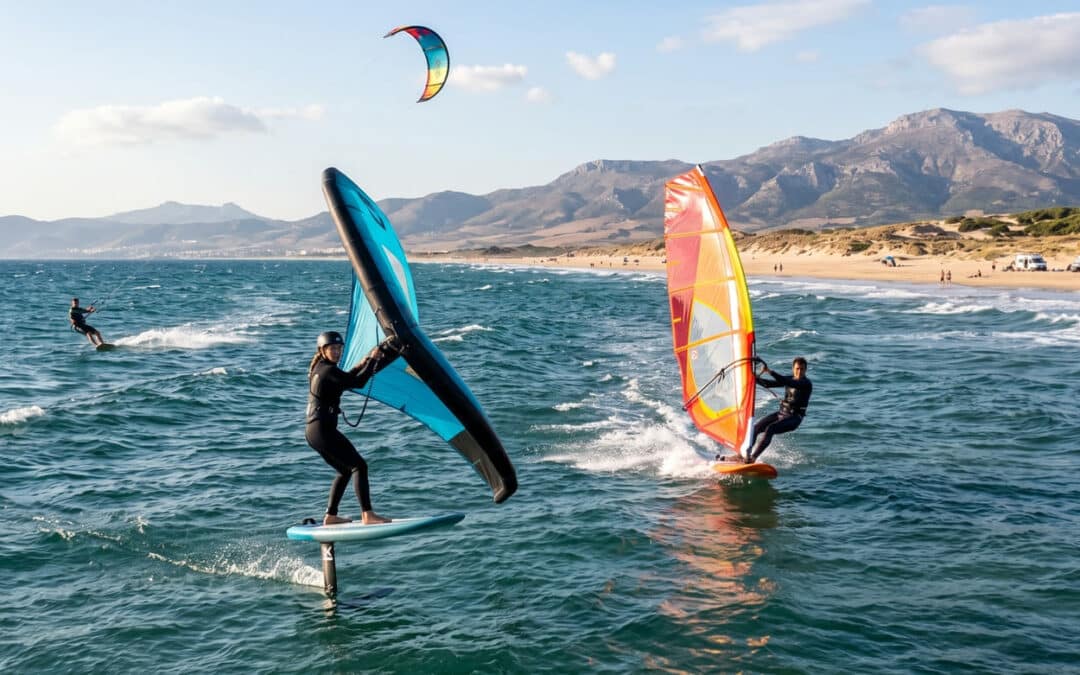
- Wingfoil (The Revolution): Combines a lightweight inflatable wing held directly in your hands with a board equipped with a hydrofoil (underwater wing). As you gain speed, the board lifts above the sea, allowing you to glide smoothly without wave drag.
Comparison Table: Which One Should You Choose?
| Evaluation Criteria | Wingfoil | Windsurf | Kitesurf |
|---|---|---|---|
| Learning Curve | Very Fast: Basic autonomy in 2-3 days. | Moderate: Learning basic maneuvers, keeping course, and turning is accessible. | Moderate: Autonomous waterstart in 3-4 days. |
| Initial Physical Effort | Low / Moderate: Lightweight inflatable wing. | High: Continuously uphauling the sail. | Low: The harness supports the pull. |
| Safety Margin | Maximum: Release the wing and it instantly depowers. | High: Slow, controlled falls near the board. | Moderate: Requires strict kite management on the beach. |
| Minimum Wind Required | Very Low (10-12 kts): Thanks to hydrofoil takeoff. | Moderate (14-16 kts): To get planing. Cruising is possible in light wind too. | Low (12-14 kts): Depending on kite size. |
| Riding Sensation | Smooth Flight: No drag or wave impact. | Direct Contact: Power and direct connection with the sea. | Jumps & Speed: High traction and acceleration. |
Which Is Easier to Learn for a Beginner?
If you have never tried water board sports, Wingfoil is objectively the discipline with the gentlest learning curve:
- Phase 1 (Wing control on the beach): In just 1 hour, you learn to handle the wing by its handles and instantly depower it by releasing your back hand.
- Phase 2 (Taxiing on a high-volume board): We use wide beginner boards that don’t sink, allowing you to stand up without stress in calm areas like Los Lances Norte Beach.
- Phase 3 (Hydrofoil Takeoff): At specialized schools like Wind & Water Experience, we equip our students with 2-way radio helmets to guide your exact body posture in real time during flight.
In contrast, Windsurfing requires significant back strength during initial lessons to uphaul the sail from the sea. Kitesurfing, while extremely rewarding once mastered, requires spending almost half of the course mastering wind window dynamics and safety protocols on the beach.
The Tarifa Lifestyle: Sports, Coworking, and Nature
Many of our students drive down on Fridays from Madrid via the N-340/A-4 or work remotely during the mornings in cozy wifi-friendly cafes in Tarifa’s historic town center. After work or the road trip, the action moves to the beach:
- Poniente Days (Steady side-onshore breeze): We head to Punta Paloma beach (also known as Valdevaqueros beach), where we run our lessons right in front of Volare chiringuito.
- Levante Days (Strong, warm offshore wind): We move to Los Lances Norte beach, operating right in front of Waves chiringuito.
And to end the day, nothing beats enjoying an acai bowl or a cold drink while watching the sunset over the African coastline.
Ready to Try Wingfoil in Tarifa?
Learn with certified instructors, real-time 2-way radio helmets, and safety rescue boat support included. Your first session awaits!
Frequently Asked Questions About Wind Sports in Tarifa
Which water sport is safest for beginners in Tarifa?
Wingfoil is one of the safest water sports because if you lose balance, you simply let go of the wing and it instantly depowers. In addition, at Wind & Water Experience, all lessons include 2-way radio helmets and official rescue boat support on the beach.
Can I learn Wingfoil without prior Kitesurfing or Windsurfing experience?
Yes, absolutely. Wingfoil is an independent discipline. You don’t need any prior wind or sailing experience. In our lessons at Los Lances and Valdevaqueros, we teach wind control and board balance completely from scratch.
Where do lessons take place when there is strong Levante wind?
We operate as a mobile school in Tarifa. When Levante blows hard, we choose the safest, most sheltered areas of Valdevaqueros Beach or Los Lances Norte, always ensuring official rescue boat coverage.
How many course days do I need to start flying on the Wingfoil?
Most students master wing handling on the beach on Day 1, cruise standing on the board on Day 2, and experience their first sustained flights on the hydrofoil between Day 2 and Day 3 of their course.
More Posts From Our Blog

Accommodation in Tarifa near the beach and Windsurf Lessons
If you are thinking of coming to Tarifa to windsurf this summer, we have the ideal accommodation...
Recent Comments